
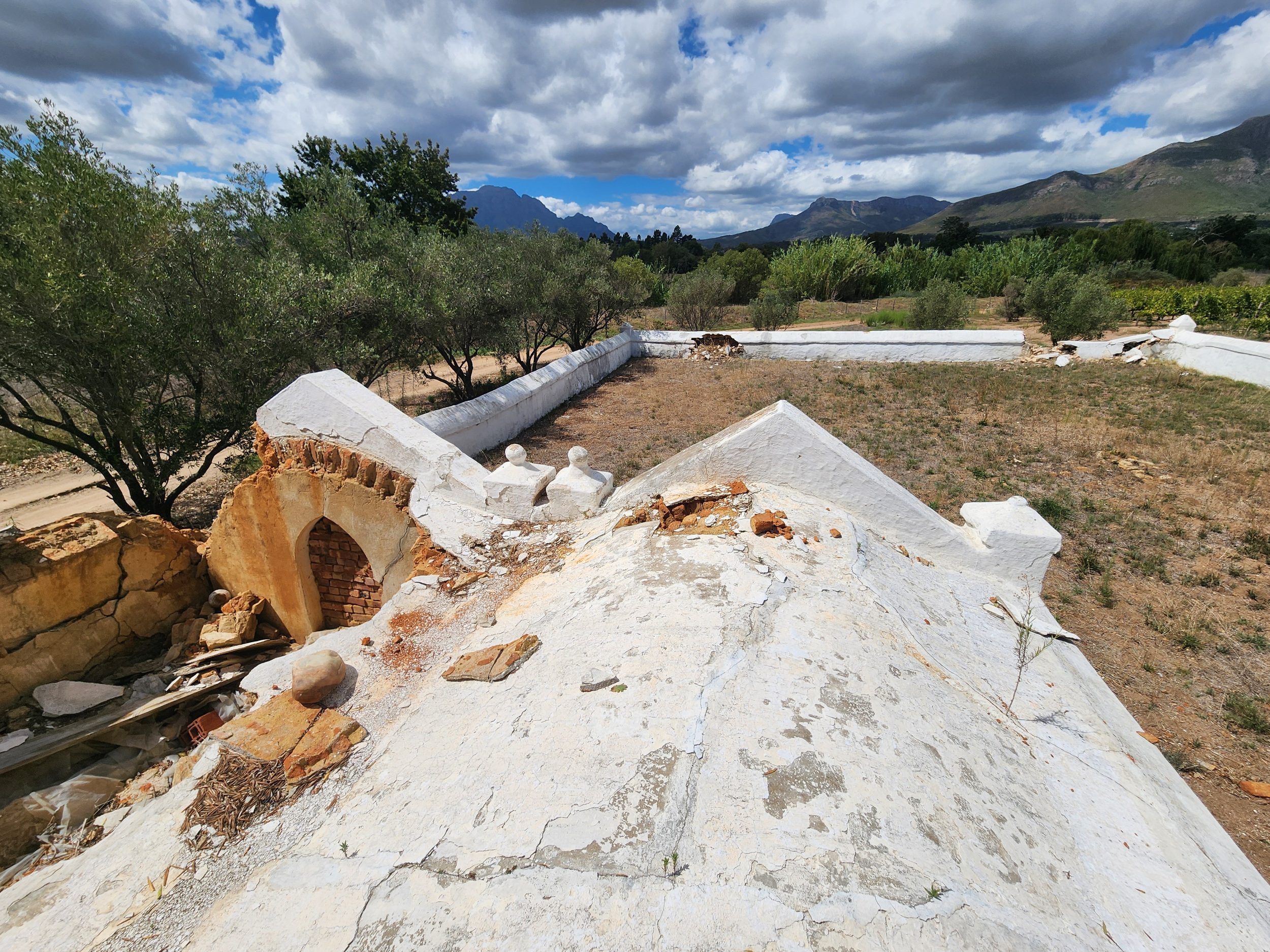
Burial vaults evoke emotions
By Nell Harris, owner at Libertas Farm & Katie Smuts, Head of Archaeology at Rennie Scurr Adendorff.
Libertas is spectacular at this time of year. The oaks are changing their leaves, the light has softened, and every season of the year the farm seems to reveal another layer of itself. During the long process of repairing and restoring an old farm, you encounter history in many forms. Some of it is beautiful. Some of it is difficult. All of it feels important.
When you have the privilege of taking care of an historic farm, you quickly realise that you are not just dealing with structures and land. You are taking responsibility for stories that took place there long before you arrived. The homestead, the werf, the cellar, the slave quarters, the old trees, the river, the murals and the burial ground all form part of the same history.
The burial vaults have been one of the parts of the farm that has evoked a lot of emotion.
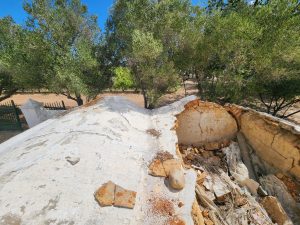
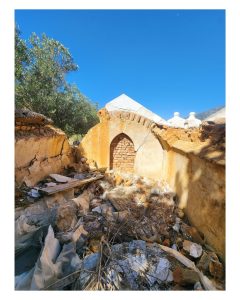
They sit some distance from the homestead, away from the main werf. The northern vault, likely the older of the two, was completely collapsed, and open to the elements. The southern vault was still intact, but with broken plaster, exposed brick, and a hole in the roof – not due to disturbance, but decay. The southern one had to be opened as part of the restoration work.
Over many years, water, weather and age had taken their toll on the vaults. Earlier generations had clearly tried to look after them, as there is evidence of old repairs, areas patched with brick and cement, but the structures had continued to deteriorate. Plaster had cracked due to the walls resting on the clay sand of Stellenbosch. In the northern vault, this had led to the roof caving in completely, resulting in significant damage to the coffins inside. In the southern vault, the hole in the roof allowed water in, accelerating the natural deterioration of the wooden coffins over the years.
It was immediately clear that this was not a normal building repair. It was a burial place, and it had to be treated as one.
The remains have therefore been carefully removed and safely stored so that the vaults can be rebuilt. They will be reinterred once the restoration is complete.
After much consultation with other heritage experts as well as Heritage Western Cape, the decision to remove the coffins was not taken lightly, but it was the respectful thing to do.
In the southern vault, there was simply too little space to rebuild safely around the collapsed coffins. The coffins were too fragile to move around or restack inside the vault. In the northern vault, some remains were already at or near the surface and would have been at risk during the building work. The alternative would have been to pour concrete over the remains and build upwards. That did not feel right, and it was not considered appropriate from a responsible heritage point of view.
So, the team took the slower route, which is to remove, store and return.
Eighteen individuals were removed from the southern vault. Some in intact coffins, others represented only by their remains, their coffins too broken and decayed to retrieve. Work in the northern vault suggested that approximately 24 people had been buried there. Around 180 coffin handles were recovered from that vault, which broadly supports that estimate, representing upward of 22 coffins. The remains of two children were also found.
Those details stay with you.
There is also a real sense of discovery. Different coffin styles can still be seen. Tin fragments, handles and small remains were recovered through careful sieving of the soil. In the southern tomb, the team found acorns carved into wood and beaten into tin decorating many of the coffins, while angel motifs beaten into metal were found in the northern vault.
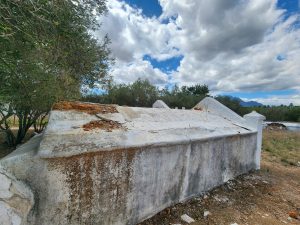
The dates also help place the vaults within the longer story of Libertas. The northern tomb carries the date 1845 on its exterior, but the burial ground itself appears in the records earlier, in 1822, after the death of the farm owner Johannes de Villiers. Before that, Libertas owners were still being buried elsewhere. Johann Bernhard Hoffman, who owned the farm in the late 18th century and commissioned Jan Adam Hartman to decorate the house interior, was the last Libertas owner buried in the Stellenbosch Moederkerk graveyard, in 1782. That shift, from the church graveyard to a burial ground on the farm, is part of what makes the vaults so important. They show how Libertas began to hold its own family history, not only in its buildings and landscape, but in the ground itself.
There is still so much we do not know. The relationship between the two vaults is not fully clear. They did not share a wall, and the space between the two vaults was later filled with brick and plaster – joining them together. But that is part of the fascination of this work. The farm keeps giving us clues. Each one helps us understand a little more about how people lived here, how they mourned, and how Libertas fitted into the wider history of Stellenbosch.
The process has also reminded us that restoration is not about making an old place look perfect, rather it is about care. It is about doing the work properly, even when it is complicated. It is about bringing in the right people, following the right heritage process and making the right decisions that respect the land and the people connected to it.
Although Libertas is private land, it forms part of a much larger Stellenbosch story. We, as owners, are not only restoring a farm for ourselves, but also protecting something that belongs, historically and emotionally, to the town as well.
The vaults are not being restored as a public attraction. They are being restored because they are part of Libertas and its history, and because leaving them to deteriorate would be the wrong kind of silence.
There is great excitement in what we are discovering, but also great responsibility.
At Libertas, we are learning that you do not really restore a place by changing it. You restore it by listening to it and respecting those who came before you.
Cover image: Photo: Arn Erasmus